
Grand Canyon Moonrise
South Rim, Grand Canyon, AZ
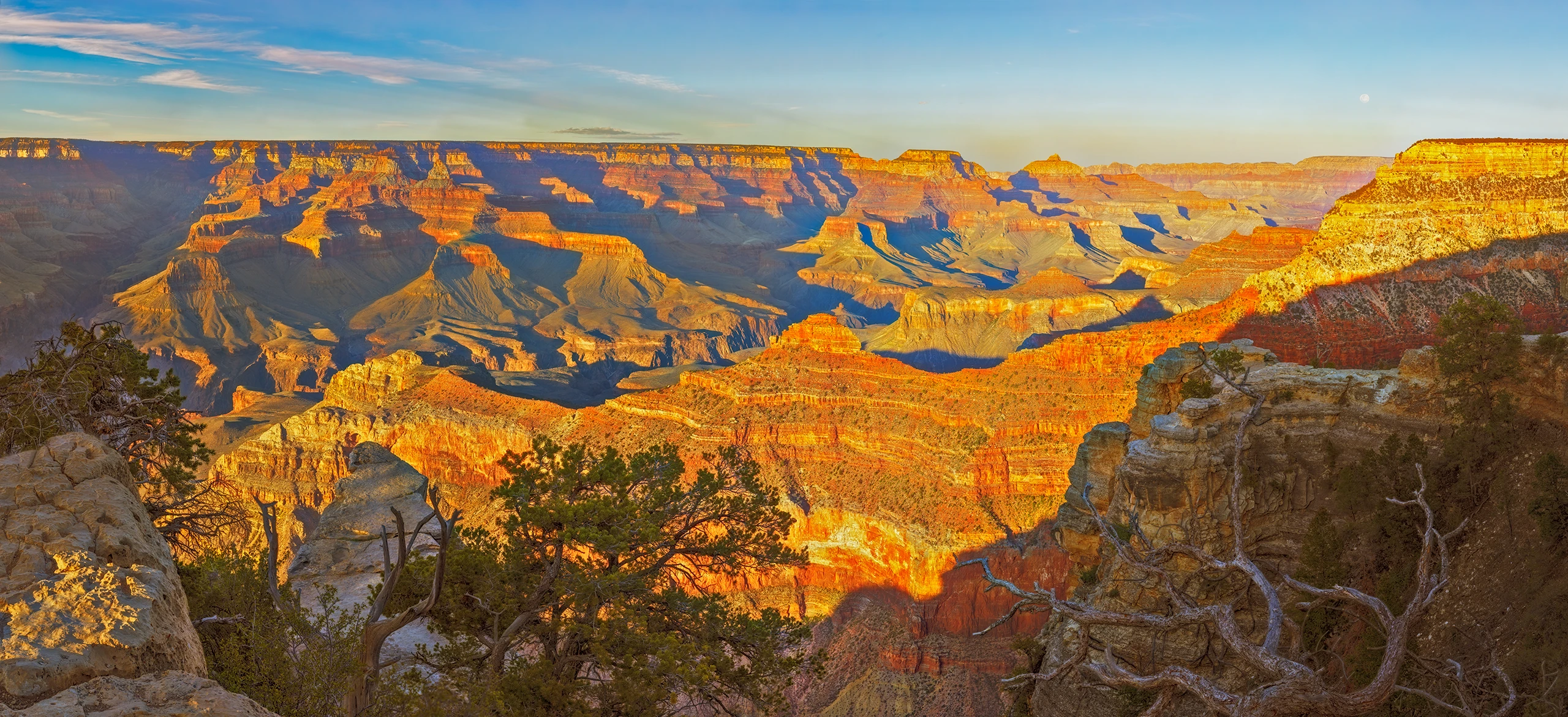 ( Click on image to access high resolution virtual tour. Not for mobile devices.)
April 15, 2022, 6:15 PM. — Jean and I were walking along the Rim Trail near Mather Point, which offers many scenic views of the canyon. At this spot, I noticed the Moon had just risen. The long shadows of the soon-to-be-setting sun were extending up the canyon, while the late afternoon sunlight was setting the high points of the canyon aglow with warm light.
The Grand Canyon is approximately 277 miles long, reaches up to 18 miles across, and in places is more than a mile deep. Its exposed sedimentary rock layers provide a remarkable window into Earth’s history. In Is Genesis History?, geologist Dr. Steve Austin presents the view that thousands of feet of sedimentary layers were deposited during the biblical Flood and that the Grand Canyon itself was subsequently carved by catastrophic drainage from large post-Flood lakes on the Colorado Plateau. Austin identifies a large body of water he calls Hopi Lake in the Painted Desert and proposes that the overtopping and failure of natural barriers released enormous quantities of water, rapidly carving the canyon through the sedimentary layers, laid down during the Flood, reaching the granite basement rock of the Earth’s original crust in a matter of weeks.
Zoroaster and Brahma Temples can be seen just right of center on the horizon. At this location, juniper trees at the top of the rim provided a nice foreground, so I set my camera rig up and photographed this focus-stacked Grand Canyon Moonrise panorama.
This is an focus stacked image shot bracketed with Canon R5, Canon 70-200mm lens at 200mm, f/11, 1/125th sec. exposure, ISO 400. It is made up of 878 Focus Bracketed images processed to yield 114 individual Focus Stacked images, 6 rows x 19 columns 30% overlap in portrait orientation.
The original image is:
- 2.278 Gigapixels
- 32,282 × 70,569 pixels
- 107.6″ × 235.2″ (8 ft. 11.6 in. × 19 ft. 7.2 in.) at 300 PPI — original image size
- Approximately 1:2.19 aspect ratio
- Available in a variety of print sizes and mounting options
- Native resolution supports wall murals up to approximately 8 ft. 11.6 in. × 19 ft. 7.2 in. at 300 PPI, or 17 ft. 11.2 in. × 39 ft. 2.5 in. at 150 PPI
- Large-format wall murals are available. Contact us to discuss custom dimensions and installation requirements.
Print Sizes and Mounting Options
Contact us for a quote on your specific size and mounting needs.
- Standard Plaque prints are available in four finish choices. Finishes are acid-free and ultraviolet (UV) light protected, shielding them against fading and deterioration, and can be wiped down with water or ammonia-free cleaners.
- We highly recommend Metalized Paper for prints, plaques and PlexiPlaq products. This special paper does an excellent job of bringing out the detail in the photographs.
- All of our plaques are produced by Duraplaq on photo-quality high-density boards. Numerous mounting styles and edge treatments are available.
- Approximate lead time for shipping prints is two to three weeks. Plaque mounts and other options are approximately three to four weeks.
The above sizes and mounting options are a small subset of the overall mounting options we offer. Our photographs are available as traditional prints, framed prints, plaque mounts, aluminum prints and PlexiPlaq. We also offer Tri-Panel, Quad-Panel, Wall Clusters & Splits, and many of our gigapixel photographs are available as wall murals. Commercial licensing is also available for a variety of applications.