
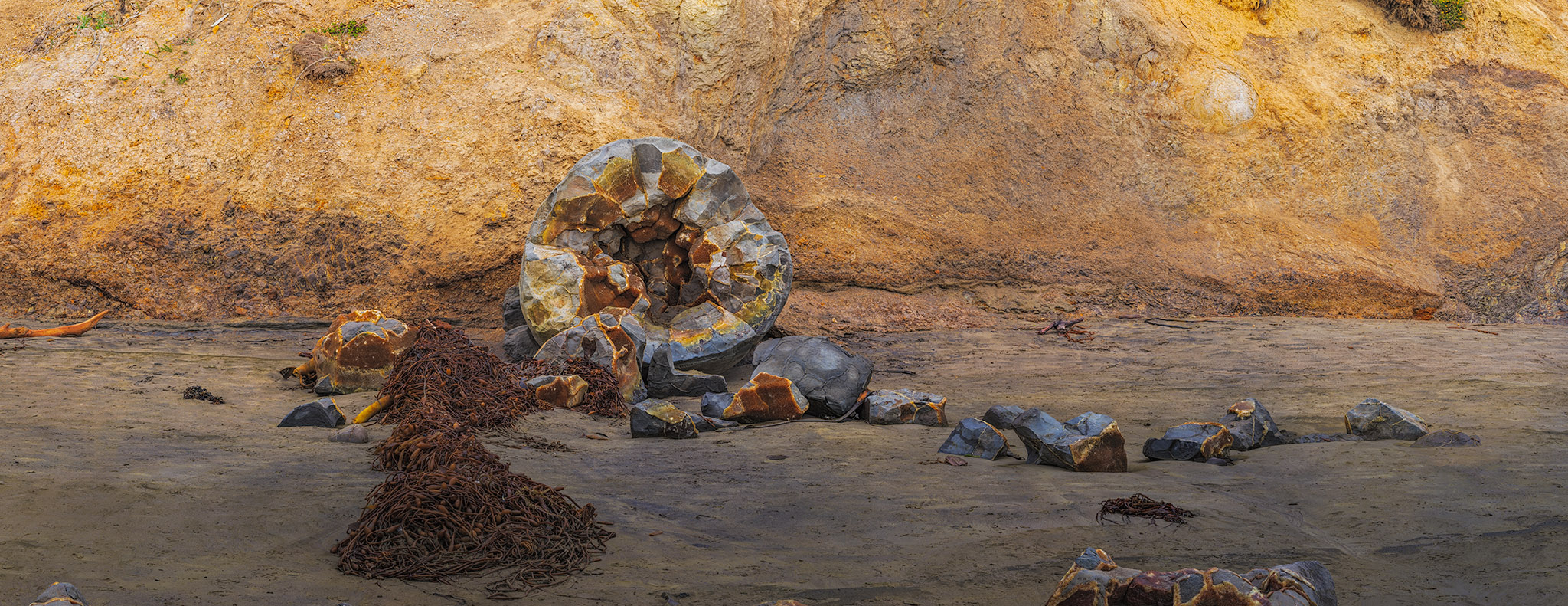
Broken Moeraki Boulder
Koekohe Beach, Moeraki, New Zealand
 ( Click on image to access high resolution virtual tour. Not for mobile devices.)
April 15, 2026 — I photographed this remarkable broken Moeraki Boulder on Koekohe Beach, near Moeraki on the Otago coast of New Zealand’s South Island.
This particular boulder, approximately five feet in diameter, had fallen from the cliff behind it several years earlier and broken apart on impact. The exposed interior reveals the unusual structure of these massive stone formations, while fragments scattered across the beach provide a striking illustration of the forces that shaped and eventually fractured them.
The Moeraki Boulders, also known as Kaihinaki, are unusually large, often nearly spherical geological concretions found along Koekohe Beach between Moeraki and Hampden. They occur individually or in clusters and are protected within a scientific reserve.
These boulders are septarian concretions that formed within ancient marine mudstone. Over time, coastal erosion exposed them from the surrounding rock, leaving them scattered along the beach. Many contain distinctive internal cracks and mineral-filled fractures that become visible when a boulder breaks open.
One of the most remarkable characteristics of the Moeraki Boulders is their size. Approximately one-third measure between 0.5 and 1.0 meters (1.6–3.3 feet) in diameter, while the remaining two-thirds range from approximately 1.5 to 2.2 meters (4.9–7.2 feet). Most are spherical or nearly spherical, although some are slightly elongated.
I created this exceptionally detailed panorama using my Canon EOS R5 Mark II and an RF 100–400mm lens set to 400mm. The exposure settings were f/11, 1/13 second, and ISO 100.
To preserve fine detail throughout the scene, I captured 6,536 individual exposures using focus bracketing. These were combined into 156 focus-stacked photographs and then stitched into a panorama arranged in six rows by 26 columns. The resulting photograph contains more than 782 million pixels, revealing intricate details of the fractured stone, surrounding cliff, and beach.
The original image is:
- 782.0 megapixels
- 18,000 × 43,445 pixels
- 60.0″ × 144.8″ at 300 PPI
- 2.41:1 aspect ratio
- Available as fine art prints, plaque mounts, aluminum prints and PlexiPlaq.
- Wall murals up to approximately 5 ft × 12 ft 1 in at 300 PPI, or 10 ft × 24 ft 2 in at 150 PPI.
- This image can be cropped to your desired dimensions.
Click here for information about purchasing a license for this image.
Print Sizes and Mounting Options
Contact us for a quote on your specific size and mounting needs.
- Standard Plaque prints are available in four finish choices. Finishes are acid-free and ultraviolet (UV) light protected, shielding them against fading and deterioration, and can be wiped down with water or ammonia-free cleaners.
- We highly recommend Metalized Paper for prints, plaques and PlexiPlaq products. This special paper does an excellent job of bringing out the detail in the photographs.
- All of our plaques are produced by Duraplaq on photo-quality high-density boards. Numerous mounting styles and edge treatments are available.
- Approximate lead time for shipping prints is two to three weeks. Plaque mounts and other options are approximately three to four weeks.
The above sizes and mounting options are a small subset of the overall mounting options we offer. Our photographs are available as traditional prints, framed prints, plaque mounts, aluminum prints and PlexiPlaq. We also offer Tri-Panel, Quad-Panel, Wall Clusters & Splits, and many of our gigapixel photographs are available as wall murals. Commercial licensing is also available for a variety of applications.